
35. Optimal Growth II: Time Iteration#
Contents
35.1. Overview#
In this lecture we’ll continue our earlier study of the stochastic optimal growth model.
In that lecture we solved the associated discounted dynamic programming problem using value function iteration.
The beauty of this technique is its broad applicability.
With numerical problems, however, we can often attain higher efficiency in specific applications by deriving methods that are carefully tailored to the application at hand.
The stochastic optimal growth model has plenty of structure to exploit for this purpose, especially when we adopt some concavity and smoothness assumptions over primitives.
We’ll use this structure to obtain an Euler equation based method that’s more efficient than value function iteration for this and some other closely related applications.
In a subsequent lecture we’ll see that the numerical implementation part of the Euler equation method can be further adjusted to obtain even more efficiency.
35.2. The Euler Equation#
Let’s take the model set out in the stochastic growth model lecture and add the assumptions that
The last two conditions are usually called Inada conditions.
Recall the Bellman equation
Let the optimal consumption policy be denoted by
We know that
The conditions above imply that
the optimal policy is continuous, strictly increasing and also interior, in the sense that
the value function is strictly concave and continuously differentiable, with
The last result is called the envelope condition due to its relationship with the envelope theorem.
To see why (35.2) might be valid, write the Bellman equation in the equivalent form
differentiate naively with respect to
Section 12.1 of EDTC contains full proofs of these results, and closely related discussions can be found in many other texts.
Differentiability of the value function and iteriority of the optimal policy imply that optimal consumption satisfies the first order condition associated with (35.1), which is
Combining (35.2) and the first-order condition (35.3) gives the famous Euler equation
We can think of the Euler equation as a functional equation
over interior consumption policies
Our aim is to solve the functional equation (35.5) and hence obtain
35.2.1. The Coleman Operator#
Recall the Bellman operator
Just as we introduced the Bellman operator to solve the Bellman equation, we will now introduce an operator over policies to help us solve the Euler equation.
This operator
Henceforth we denote this set of policies by
The operator
returns a new function
We call this operator the Coleman operator to acknowledge the work of [Col90] (although many people have studied this and other closely related iterative techniques).
In essence,
The important thing to note about
In particular, the optimal policy
Indeed, for fixed
In view of the Euler equation, this is exactly
35.2.2. Is the Coleman Operator Well Defined?#
In particular, is there always a unique
The answer is yes, under our assumptions.
For any
is continuous and strictly increasing in
diverges to
The left side of (35.7)
is continuous and strictly decreasing in
diverges to
Sketching these curves and using the information above will convince you that they cross exactly once as
With a bit more analysis, one can show in addition that
35.3. Comparison with Value Function Iteration#
How does Euler equation time iteration compare with value function iteration?
Both can be used to compute the optimal policy, but is one faster or more accurate?
There are two parts to this story.
First, on a theoretical level, the two methods are essentially isomorphic.
In particular, they converge at the same rate.
We’ll prove this in just a moment.
The other side to the story is the speed of the numerical implementation.
It turns out that, once we actually implement these two routines, time iteration is faster and more accurate than value function iteration.
35.3.1. Equivalent Dynamics#
Let’s talk about the theory first.
To explain the connection between the two algorithms, it helps to understand the notion of equivalent dynamics.
(This concept is very helpful in many other contexts as well).
Suppose that we have a function
The pair
Equivalently,
Here’s the picture

Now let another function
Suppose further that
there exists a bijection
the two functions commute under
The last statement can be written more simply as
or, by applying
Here’s a commutative diagram that illustrates
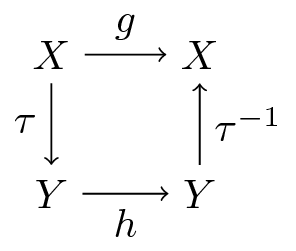
Here’s a similar figure that traces out the action of the maps on a point
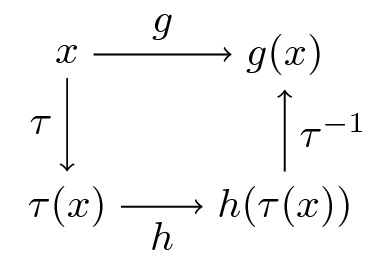
Now, it’s easy to check from (35.8) that
In fact, if you like proofs by induction, you won’t have trouble showing that
is valid for all
What does this tell us?
It tells us that the following are equivalent
iterate
shift
We end up with exactly the same object.
35.3.2. Back to Economics#
Have you guessed where this is leading?
What we’re going to show now is that the operators
The implication is that they have exactly the same rate of convergence.
To make life a little easier, we’ll assume in the following analysis (although not
always in our applications) that
35.3.2.1. A Bijection#
Let
For
Although we omit details,
See proposition 12.1.18 of EDTC
It turns out that
A (solved) exercise below asks you to confirm this.
35.3.2.2. Commutative Operators#
It is an additional solved exercise (see below) to show that
In view of the preceding discussion, this implies that
Hence,
35.4. Implementation#
We’ve just shown that the operators
However, it turns out that, once numerical approximation is taken into account, significant differences arises.
In particular, the image of policy functions under
Our intuition for this result is that
the Coleman operator exploits more information because it uses first order and envelope conditions
policy functions generally have less curvature than value functions, and hence admit more accurate approximations based on grid point information
35.4.1. The Operator#
Here’s some code that implements the Coleman operator.
using LinearAlgebra, Statistics
using BenchmarkTools, Interpolations, LaTeXStrings,  Plots, Roots
using Optim, Random
using BenchmarkTools, Interpolations, Plots, Roots
function K!(Kg, g, grid, beta, dudc, f, f_prime, shocks)
    # This function requires the container of the output value as argument Kg

    # Construct linear interpolation object
    g_func = LinearInterpolation(grid, g, extrapolation_bc = Line())

    # solve for updated consumption value
    for (i, y) in enumerate(grid)
        function h(c)
            vals = dudc.(g_func.(f(y - c) * shocks)) .* f_prime(y - c) .* shocks
            return dudc(c) - beta * mean(vals)
        end
        Kg[i] = find_zero(h, (1e-10, y - 1e-10))
    end
    return Kg
end

# The following function does NOT require the container of the output value as argument
function K(g, grid, beta, dudc, f, f_prime, shocks)
    K!(similar(g), g, grid, beta, dudc, f, f_prime, shocks)
end
K (generic function with 1 method)
It has some similarities to the code for the Bellman operator in our optimal growth lecture.
For example, it evaluates integrals by Monte Carlo and approximates functions using linear interpolation.
Here’s that Bellman operator code again, which needs to be executed because we’ll use it in some tests below
using Optim

function T(w, grid, beta, u, f, shocks, Tw = similar(w);
           compute_policy = false)

    # apply linear interpolation to w
    w_func = LinearInterpolation(grid, w, extrapolation_bc = Line())

    if compute_policy
        sigma = similar(w)
    end

    # set Tw[i] = max_c { u(c) + beta E w(f(y  - c) z)}
    for (i, y) in enumerate(grid)
        objective(c) = u(c) + beta * mean(w_func.(f(y - c) .* shocks))
        res = maximize(objective, 1e-10, y)

        if compute_policy
            sigma[i] = Optim.maximizer(res)
        end
        Tw[i] = Optim.maximum(res)
    end

    if compute_policy
        return Tw, sigma
    else
        return Tw
    end
end
T (generic function with 2 methods)
35.4.2. Testing on the Log / Cobb–Douglas case#
As we did for value function iteration, let’s start by testing our method in the presence of a model that does have an analytical solution.
Here’s an object containing data from the log-linear growth model we used in the value function iteration lecture
isoelastic(c, gamma) = isone(gamma) ? log(c) : (c^(1 - gamma) - 1) / (1 - gamma)
function Model(; alpha = 0.65,                         # Productivity parameter
               beta = 0.95,                            # Discount factor
               gamma = 1.0,                             # Risk aversion
               mu = 0.0,                             # First parameter in lognorm(mu, sigma)
               s = 0.1,                             # Second parameter in lognorm(mu, sigma)
               grid = range(1e-6, 4, length = 200), # Grid
               grid_min = 1e-6,                     # Smallest grid point
               grid_max = 4.0,                      # Largest grid point
               grid_size = 200,                     # Number of grid points
               u = (c, gamma = gamma) -> isoelastic(c, gamma),  # utility function
               dudc = c -> c^(-gamma),                  # u_prime
               f = k -> k^alpha,                        # production function
               f_prime = k -> alpha * k^(alpha - 1))
    return (; alpha, beta, gamma, mu, s, grid, grid_min, grid_max, grid_size, u,
            dudc, f, f_prime)
end
Model (generic function with 1 method)
Next we generate an instance
m = Model();
We also need some shock draws for Monte Carlo integration
using Random
Random.seed!(42) # for reproducible results.

shock_size = 250 # number of shock draws in Monte Carlo integral
shocks = collect(exp.(m.mu .+ m.s * randn(shock_size))); # generate shocks
As a preliminary test, let’s see if
function verify_true_policy(m, shocks, c_star)
    # compute (Kc_star)
    (; grid, beta, dudc, f, f_prime) = m
    c_star_new = K(c_star, grid, beta, dudc, f, f_prime, shocks)

    # plot c_star and Kc_star
    plot(grid, c_star, label = L"optimal policy $c^*$")
    plot!(grid, c_star_new, label = L"Kc^*")
    plot!(legend = :topleft)
end
verify_true_policy (generic function with 1 method)
c_star = (1 - m.alpha * m.beta) * m.grid # true policy (c_star)
verify_true_policy(m, shocks, c_star)
We can’t really distinguish the two plots, so we are looking good, at least for this test.
Next let’s try iterating from an arbitrary initial condition and see if we
converge towards
The initial condition we’ll use is the one that eats the whole pie:
function check_convergence(m, shocks, c_star, g_init; n_iter = 15)
    (; grid, beta, dudc, f, f_prime) = m
    g = g_init
    plot(m.grid, g, lw = 2, alpha = 0.6, label = L"intial condition $c(y) = y$")
    for i in 1:n_iter
        new_g = K(g, grid, beta, dudc, f, f_prime, shocks)
        g = new_g
        plot!(grid, g, lw = 2, alpha = 0.6, label = "")
    end
    plot!(grid, c_star, color = :black, lw = 2, alpha = 0.8,
          label = L"true policy function $c^*$")
    plot!(legend = :topleft)
end
check_convergence (generic function with 1 method)
check_convergence(m, shocks, c_star, m.grid, n_iter = 15)
We see that the policy has converged nicely, in only a few steps.
Now let’s compare the accuracy of iteration using the Coleman and Bellman operators.
We’ll generate
In each case we’ll compare the resulting policy to
The theory on equivalent dynamics says we will get the same policy function and hence the same errors.
But in fact we expect the first method to be more accurate for reasons discussed above
function iterate_updating(func, arg_init; sim_length = 20)
    arg = arg_init
    for i in 1:sim_length
        new_arg = func(arg)
        arg = new_arg
    end
    return arg
end

function compare_error(m, shocks, g_init, w_init; sim_length = 20)
    (; grid, beta, u, dudc, f, f_prime) = m
    g, w = g_init, w_init

    # two functions for simplification
    bellman_single_arg(w) = T(w, grid, beta, u, f, shocks)
    coleman_single_arg(g) = K(g, grid, beta, dudc, f, f_prime, shocks)

    g = iterate_updating(coleman_single_arg, grid, sim_length = 20)
    w = iterate_updating(bellman_single_arg, u.(grid), sim_length = 20)
    new_w, vf_g = T(w, grid, beta, u, f, shocks, compute_policy = true)

    pf_error = c_star - g
    vf_error = c_star - vf_g

    plot(grid, zero(grid), color = :black, lw = 1, label = "")
    plot!(grid, pf_error, lw = 2, alpha = 0.6, label = "policy iteration error")
    plot!(grid, vf_error, lw = 2, alpha = 0.6, label = "value iteration error")
    plot!(legend = :bottomleft)
end
compare_error (generic function with 1 method)
compare_error(m, shocks, m.grid, m.u.(m.grid), sim_length = 20)
As you can see, time iteration is much more accurate for a given number of iterations.
35.5. Exercises#
35.5.1. Exercise 1#
Show that (35.9) is valid. In particular,
Let
Fix
35.5.2. Exercise 2#
Show that
35.5.3. Exercise 3#
Consider the same model as above but with the CRRA utility function
Iterate 20 times with Bellman iteration and Euler equation time iteration
start time iteration from
start value function iteration from
set
Compare the resulting policies and check that they are close.
35.5.4. Exercise 4#
Do the same exercise, but now, rather than plotting results, benchmark both approaches with 20 iterations.
35.6. Solutions#
35.6.1. Solution to Exercise 1#
Let
Using the envelope theorem, one can show that
Hence
On the other hand,
We see that
35.6.2. Solution to Exercise 2#
We need to show that
To see this, first observe that, in view of our assumptions above,
It follows that
Moreover, for fixed
Hence, for fixed
Moreover, interiority holds because
In particular,
To see that each
Let
With a small amount of effort you will be able to show that
It’s also true that
To see this, suppose that
Then
The fundamental theorem of calculus then implies that
35.6.3. Solution to Exercise 3#
Here’s the code, which will execute if you’ve run all the code above
# Model instance with risk aversion = 1.5
# others are the same as the previous instance
m_ex = Model(gamma = 1.5);
function exercise2(m, shocks, g_init = m.grid, w_init = m.u.(m.grid);
                   sim_length = 20)
    (; grid, beta, u, dudc, f, f_prime) = m
    # initial policy and value
    g, w = g_init, w_init
    # iteration
    bellman_single_arg(w) = T(w, grid, beta, u, f, shocks)
    coleman_single_arg(g) = K(g, grid, beta, dudc, f, f_prime, shocks)

    g = iterate_updating(coleman_single_arg, grid, sim_length = 20)
    w = iterate_updating(bellman_single_arg, u.(m.grid), sim_length = 20)
    new_w, vf_g = T(w, grid, beta, u, f, shocks, compute_policy = true)

    plot(grid, g, lw = 2, alpha = 0.6, label = "policy iteration")
    plot!(grid, vf_g, lw = 2, alpha = 0.6, label = "value iteration")
    return plot!(legend = :topleft)
end
exercise2 (generic function with 3 methods)
exercise2(m_ex, shocks, m.grid, m.u.(m.grid), sim_length = 20)
The policies are indeed close.
35.6.4. Solution to Exercise 4#
Here’s the code.
It assumes that you’ve just run the code from the previous exercise
function bellman(m, shocks)
    (; grid, beta, u, dudc, f, f_prime) = m
    bellman_single_arg(w) = T(w, grid, beta, u, f, shocks)
    iterate_updating(bellman_single_arg, u.(grid), sim_length = 20)
end
function coleman(m, shocks)
    (; grid, beta, dudc, f, f_prime) = m
    coleman_single_arg(g) = K(g, grid, beta, dudc, f, f_prime, shocks)
    iterate_updating(coleman_single_arg, grid, sim_length = 20)
end
coleman (generic function with 1 method)
@benchmark bellman(m_ex, shocks)
BenchmarkTools.Trial: 47 samples with 1 evaluation per sample.
 Range (min … max):  105.362 ms … 143.433 ms  ┊ GC (min … max): 3.15% … 13.78%
 Time  (median):     105.795 ms               ┊ GC (median):    3.43%
 Time  (mean ± σ):   107.798 ms ±   7.884 ms  ┊ GC (mean ± σ):  3.89% ±  1.65%

  █
  █▇▁▅▁▁▁▁▁▁▁▁▁▁▁▁▁▁▁▁▁▁▁▁▁▁▁▁▁▁▁▁▁▁▁▁▁▅▁▁▁▁▁▁▁▁▁▁▁▁▁▁▁▅▁▁▁▁▁▁▅ ▁
  105 ms        Histogram: log(frequency) by time        143 ms <

 Memory estimate: 142.09 MiB, allocs estimate: 151962.
@benchmark bellman(m_ex, shocks)
BenchmarkTools.Trial: 47 samples with 1 evaluation per sample.
 Range (min … max):  105.756 ms … 142.888 ms  ┊ GC (min … max): 3.38% … 13.26%
 Time  (median):     106.057 ms               ┊ GC (median):    3.59%
 Time  (mean ± σ):   108.128 ms ±   7.947 ms  ┊ GC (mean ± σ):  4.05% ±  1.63%

  █
  █▆▅▅▁▁▁▁▁▁▁▁▁▁▁▁▁▁▁▁▁▁▁▁▁▁▁▁▁▁▁▁▁▁▁▁▁▁▁▅▁▁▁▁▁▁▁▁▁▁▁▁▁▁▁▁▅▁▁▁▅ ▁
  106 ms        Histogram: log(frequency) by time        143 ms <

 Memory estimate: 142.09 MiB, allocs estimate: 151962.